
By role
For IT Operations
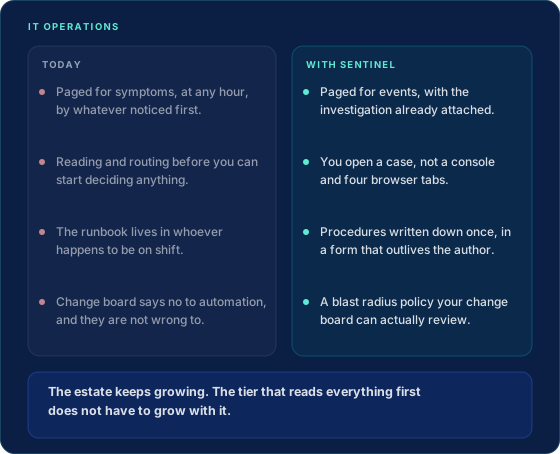
You are outnumbered by your own estate and the tooling budget is not going up. This is what changes when the platform investigates before it notifies you, and acts only where you have written down that it may.
- OutnumberedYour estate grows faster than the team watching it, and no headcount plan closes that gap.The problem in one line
- Per actionAutonomy is granted one action at a time, on what it can break, never by a switch.How you keep control
- Written downEvery automated fix is a procedure, which is the only form of a runbook that survives attrition.What you keep
- Phase oneCorrelation with nothing paging differently, so you compare against your own baseline.How it starts
What actually costs you
Three things, and none of them is a tooling gap
These are the problems we hear described in the same words on almost every estate. Each one is structural rather than a failure of effort, which is why buying another point tool has not fixed them.
The estate outgrew the tier watching it
Containers, multiple clouds and hybrid estates multiplied both the number of things that can fail and the number of tools that will tell you about it. The tier whose job is to read everything first did not multiply with them, and cannot.
The knowledge is in people, not systems
The engineer who knows why that job fails every month is the documentation. When they leave, the estate gets harder to run and nothing on any dashboard shows it happening.
Nobody will approve automation you cannot bound
Every operations team that has been burned by an ungoverned script is right to refuse the next one. The blocker is not appetite, it is that no one could answer what happens when it is wrong.
What changes
The two decisions that matter for your role
The mechanism is the same across the platform and is set out on the solution pages. What is worth your time here is how it lands on the specific work you are accountable for.
What it is allowed to do to your estate
Actions are granted individually, on the blast radius of the action rather than on how confident a model was. Restarting a pod behind healthy replicas is a different decision from draining a stateful node, and the policy says so in those terms.
Every procedure in the current library still requires approval. Nothing arrives switched on, and some actions are designed never to move at all.
What your change board actually gets
A pre-check that asserts the conditions at execution time, a post-check verified against live signals rather than exit codes, a rollback armed before anything runs, and a named owner on the ticket.
Those are properties of the action, not claims about the AI, which means they can be argued with and written into policy in the language your change process already uses.
See it on a real fault
Four walkthroughs from your side of the desk
Each one follows a specific fault end to end: what arrived, what was correlated, what ran and where the boundary of autonomy sat.
Being straight with you
What we are not going to claim
Questions we get asked
Frequently asked questions
How long before this is doing anything useful?
Phase one turns correlation on with nothing paging differently, so the first useful output is a comparison between what the platform would have delivered and what actually got delivered. That is useful immediately and it is built from your data rather than ours.
Do we have to replace our monitoring tools?
No. The platform ingests from the tooling you already run and normalises it so the join is possible. Replacing detection is expensive, disruptive and does not address the problem, which was never that any individual tool was blind.
What stops it doing something catastrophic?
The gate is the blast radius of the action, written into policy in advance by you. Anything carrying service impact is held for a named owner with the plan and rollback attached, and an action with no viable rollback is not eligible to run unattended at all.
What happens to the runbooks we already have?
They become the starting library. A written runbook is most of the way to a procedure already; what gets added is the pre-check, the post-check and the rollback, which is the part that makes it safe to run without somebody watching.
Go deeper
Where to read next
- SolutionAutonomous L1 OperationsThe tier that carries the most volume and the least tolerance for a wrong action.
- SolutionGoverned Autonomous ExecutionHow an action earns the right to run alone, and which ones never will.
- SolutionIncident Triage and CorrelationWhat has to happen before anything reaches your queue.
Bring us the alert that wakes someone every week
We will walk through what correlating it on arrival would have produced, whether it is a candidate for a written procedure, and what its pre-check would have to assert before anyone let it run.