
By role
For the NOC and Command Centre
Wall boards do not reduce time to repair. What reduces it is arriving at the fault with the correlation already done, the cause already proposed and the procedure already approved.
- On arrivalSignals correlate as they land, across every connected system, whether or not anyone is watching.How the loop is ordered
- Four axesTopology, time window, signature and change, rather than grouping by time alone.How the join is made
- RecordedEvery suppression is retained with the rule that caused it, so a quiet console can be checked.A design constraint
- 27,000+Devices under one governed NOC in the deployment behind the figures on this page.Counted at go-live
What actually costs you
Three things, and none of them is a tooling gap
These are the problems we hear described in the same words on almost every estate. Each one is structural rather than a failure of effort, which is why buying another point tool has not fixed them.
The wall board is a symptom display
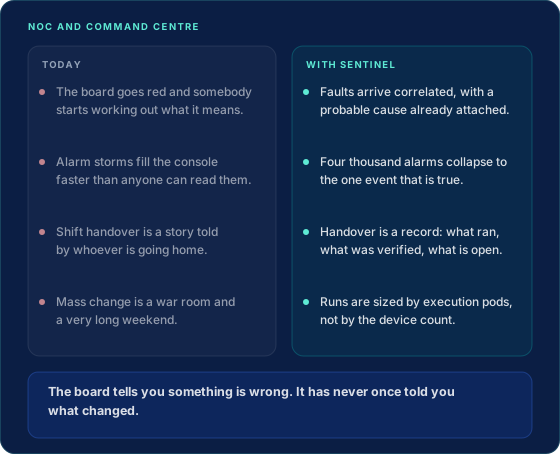
A board tells you something is red. It does not tell you which of the forty red things are the same fault, what changed in the last two hours, or who owns the service underneath. Every one of those is a question somebody has to go and answer.
Shift change is where context dies
What the outgoing shift knows is transferred by talking. Whatever does not fit into the handover window is lost, and the incoming shift rediscovers it at three in the morning, usually during the same fault.
Storms are an arithmetic problem
One failing upstream component raises alarms on everything downstream of it. The console length describes your topology, not your outage, and no amount of staffing changes that arithmetic.
What changes
The two decisions that matter for your role
The mechanism is the same across the platform and is set out on the solution pages. What is worth your time here is how it lands on the specific work you are accountable for.
Mass change without the war room
A procedure that walks thousands of nodes one at a time turns a maintenance window into a weekend. The execution engine sizes the run instead, starting pods appropriate to the work, with each pod handling many targets.
Pod count follows batch size, concurrency limits and the blast radius policy for the action, never the device count. Every node still gets its own pre-check and its own post-check.
Verification is the step everyone skips
A command returning zero is not a service recovering. The component that runs the fix is deliberately not the component that decides whether it worked, and the one that decides is built to return a verdict nobody wanted.
The most common such verdict is that the symptom cleared while the cause stayed in place, which is precisely the state that produces the same fault again next week.
How it holds at fleet scaleHow verification and citation work
See it on a real fault
Four walkthroughs from your side of the desk
Each one follows a specific fault end to end: what arrived, what was correlated, what ran and where the boundary of autonomy sat.
- Telemetry OpsFour thousand subscribers dark, four thousand alarmsRead the walkthrough →
- Telemetry OpsThe break is somewhere on forty kilometres of fibreRead the walkthrough →
- Service OpsTwo hundred ATM tickets, one upstream causeRead the walkthrough →
- Telemetry OpsThe port was dying for nine days before anyone lookedRead the walkthrough →
Being straight with you
What we are not going to claim
Questions we get asked
Frequently asked questions
We already have a manager of managers. How is this different?
A manager of managers consolidates alarms into one console, which is necessary and not sufficient. What follows it here is investigation before anyone is notified, a probable cause with its evidence attached, and where policy allows it a governed procedure that resolves the event. Consolidation on its own still hands the floor a tidier list.
Can it ingest our existing SNMP and streaming paths?
Yes. The recorded carrier deployment unified three ingestion paths: SNMP traps and metrics, Kafka streams, and poll-based collection, alongside the monitoring tools already in place. Normalising them into one shape is what makes correlation possible at all.
What about devices that need a live check?
Those run as procedures with a pre-check that asserts the device state at execution time rather than trusting a cached record. If the pre-check fails, the step halts instead of proceeding on a stale assumption.
Does this work air-gapped?
Yes. The execution engine, the audit store and the reasoning layer all run inside the customer perimeter with no egress required, which is the deployment model most carrier and defence estates need.
Go deeper
Where to read next
Bring us your worst alarm storm
The one that fills the console every few weeks and gets closed in bulk. We will walk through how it correlates on topology and change, and what the surviving event would have carried into the shift.