
Solution
Autonomous L1 Operations
L1 is not a skill problem. It is a volume problem with a routing problem on top. Sentinel takes the repetitive tier, resolves what it is permitted to resolve, and hands everything else up with the investigation already done.
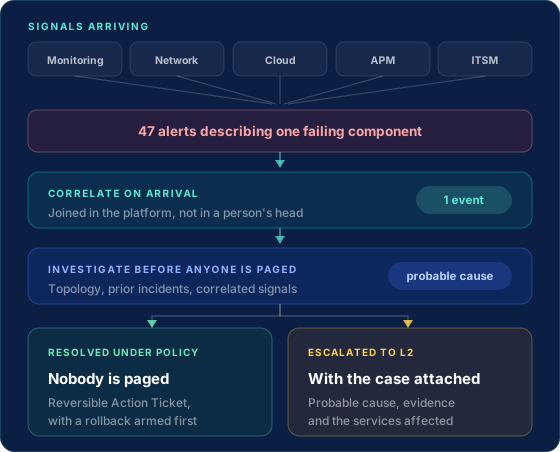
- One eventAlerts from every tool watching a failing component collapse into a single investigated event.What the queue becomes
- Before the pageInvestigation runs before anyone is notified, not after somebody opens a console.How the loop is ordered
- Three phasesCorrelation first, then approved procedures, then autonomy granted per action.How we deploy it
- Written downEvery autonomous resolution is a procedure in executable form, which is the only form that survives attrition.Why it outlasts the shift
What it changes
What moving L1 into the platform actually buys you
Four things, and none of them is a headcount promise. Very little of an L1 shift is spent fixing anything: most of it goes on deciding whether something matters, working out which alerts describe one event, finding the runbook, and deciding who to send it to. That work is necessary, it is almost entirely reading and routing, and it is the part that scales worst.
Detect before the business does
Signals correlate on arrival rather than after somebody notices, and the investigation runs before anyone is paged. The first party to know is not the customer.
Restore faster, with the case already built
What escalates arrives carrying probable cause, the correlated signals and the services affected. L2 starts from a finding rather than from a blank console.
Spend the shift on judgement, not transcription
Reading, joining, matching and routing move into the platform. What people are paid to do is the work that actually rewards a person doing it.
Keep the knowledge when people leave
Every autonomous resolution is a procedure written in executable form. That is the only form of an engineer's knowledge that survives their notice period.
How it works
Correlate, investigate, then resolve or escalate
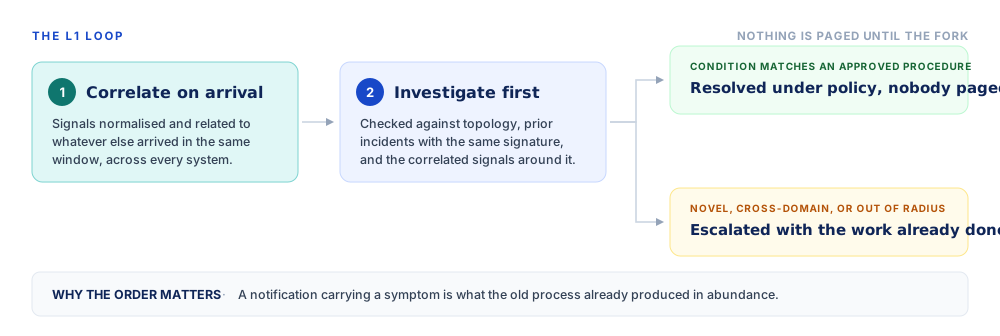
The order is the whole design. Correlation happens on arrival rather than after somebody notices. Investigation happens before anyone is paged. Only then does the loop fork, and which branch it takes depends on whether the condition matches an approved procedure and whether the action sits inside its permitted blast radius.
What it means for the team
The tier does not disappear, it changes shape
We are not going to tell you this removes the L1 function. What it removes is the part of L1 that is transcription. What remains is the part that needs judgement, and that part gets more interesting rather than less, because the volume in front of it is now events rather than alerts.
One half is transcription, the other is judgement
Knowledge written as a procedure survives attrition The queue in front of the team is events, not alerts Nobody is asked to approve what they cannot see
The split is not about seniority. It is about which work rewards a person doing it. Reading, joining, matching and routing are mechanical and repeat forever. Deciding what a novel pattern means, and owning a change that carries risk, do not.
- Knowledge written as a procedure survives attrition
- The queue in front of the team is events, not alerts
- Nobody is asked to approve what they cannot see
It does not start with autonomy
The first phase turns correlation on with nothing paging differently, so you can compare what the platform would have delivered against what actually got delivered. That comparison is the argument for phase two, and you make it with your own data rather than ours.
Autonomy is the third phase, granted per action on the evidence from the second, and only for actions whose blast radius allows it.
The same story from the NOC floorTalk through a phase-one scope
See it on a real fault
Four incidents this describes
Each one walks a specific fault end to end: what arrived, what correlated it, what resolved under policy and what escalated with the case attached.
Being straight with you
What we are not going to claim
We have production deployments recorded across this site, and none of them is a clean comparison for an L1 tier. So we are not going to borrow their numbers for this page. What determines the answer for your estate is two things, and both of them are measurable before anyone signs anything.
See what we do have recorded, with the basis on every figure
Questions we get asked
Frequently asked questions
Does this replace the L1 team?
It replaces the part of L1 that is reading, correlating and routing. The judgement work remains and gets a better queue in front of it. We are careful about this claim because the honest version is more useful to you than the exciting version when you are planning a shift roster.
What fraction of incidents can actually resolve autonomously?
It depends on two things, and both can be measured with you before anyone commits to a number: how repetitive your incident volume genuinely is, and how many procedures already exist in writing. That is what phase one is for. Anyone who gives you a percentage before looking at your alert history is quoting somebody else's estate.
How is this different from alert correlation tooling?
Correlation collapses noise into events, which is necessary and not sufficient. What follows it here is investigation before anyone is notified, a probable cause with the evidence attached, and where policy allows it a governed procedure that resolves the event. Correlation alone still hands a human a tidier list of things to go and work on.
What happens to incidents it cannot resolve?
They escalate with the investigation attached: probable cause, the correlated signals, the topology path and the services affected. The engineer starts from a case rather than from a blank console. That handoff is where most of the recovered time comes from, not from the autonomous resolutions.
Do we need to write procedures before we start?
For phase one and two, no. Correlation and investigation work against the signals you already produce. Autonomous resolution does need procedures, and if yours are undocumented that work is real. Writing them is also the part that survives your best engineer leaving, so it is worth doing regardless.
Go deeper
Where to read next
- SolutionGoverned Autonomous ExecutionHow an action earns the right to run alone, gated on blast radius rather than on model confidence.
- PlatformSentinel AIThe Orchestrator, Co-Pilot, ProcBot and Sherlock, and which one does what inside a single incident.
- By roleNOC and Command CentreThe same change described from the floor, in the language of shift handover and escalation policy.
Bring us your worst recurring incident
The one that comes back every month and gets fixed the same way every time. We will walk through what correlating it on arrival would look like, whether it is a candidate for a governed procedure, and what its pre-check would have to assert.